Next-Gen AI is changing how we work, create, and solve problems. New models now go beyond simple chat. They help teams write code, analyze data, and plan business strategies. Tools like Gemini 3.1 Pro, Claude 4.6, and GPT-5.3 Codex are leading this shift. They promise faster answers, deeper thinking, and better support across many tasks.
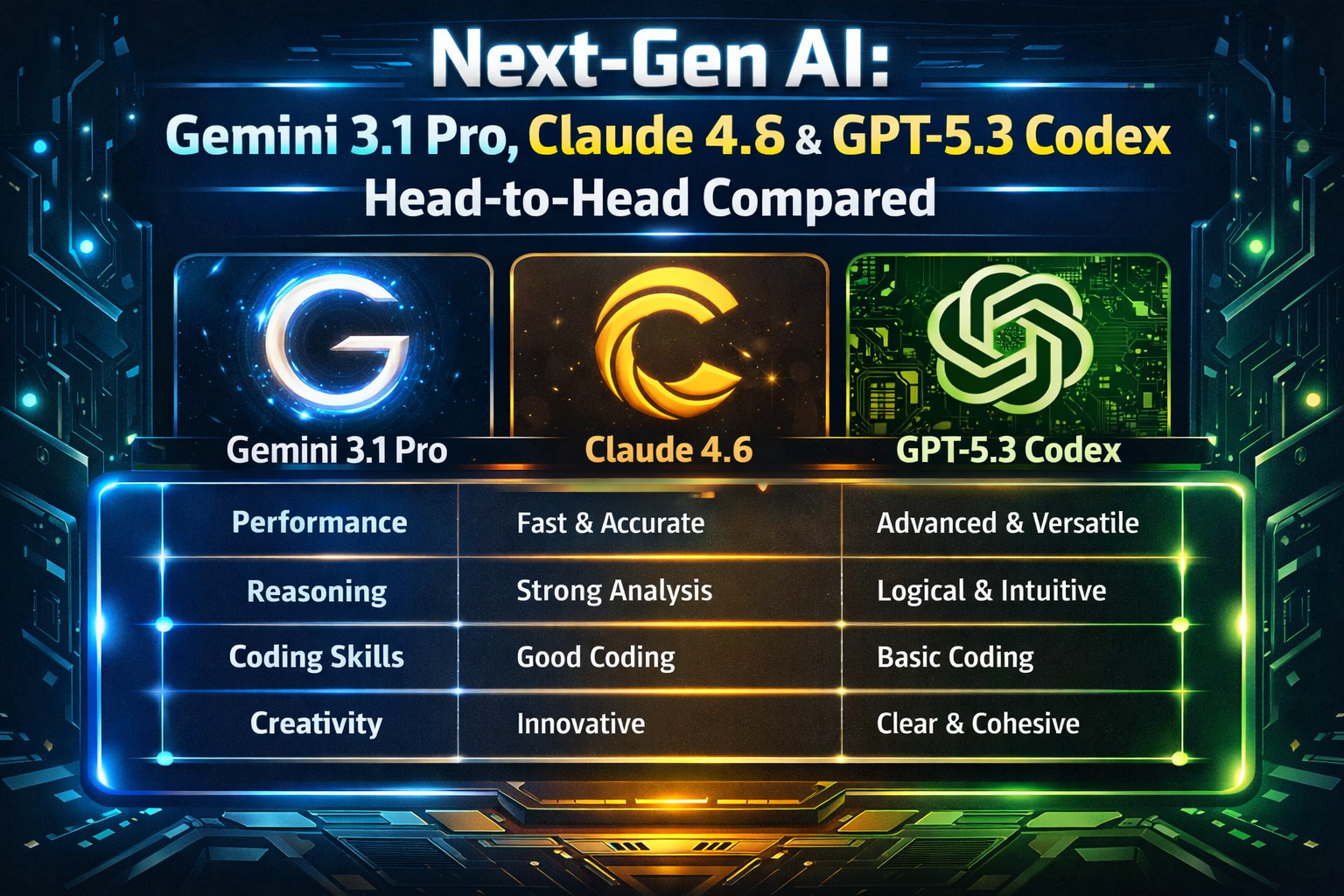
As competition grows, users in the USA and UK want clear comparisons before choosing a model. Our guide will explain strengths, limits, and real use cases. The goal is simple: help you pick the right Next-Gen AI for your needs and avoid costly mistakes.
What Defines Next-Gen AI in 2026
The term Next-Gen AI now means more than smart chat. It reflects systems that reason, plan, and act with high accuracy. These tools solve real problems, support business workflows, and help users make better decisions. Instead of giving basic answers, they understand context, adapt to different situations, and improve over time.
In 2026, the biggest shift is that Next-Gen AI focuses on outcomes. Companies no longer measure success by how fast a model responds. They look at how well it supports productivity, reduces risk, and improves long-term performance. As a result, organizations see these systems as digital partners that support daily work.
Modern systems focus on the following core capabilities:
- Clear reasoning and structured thinking
These models break problems into steps. They explain logic, reduce confusion, and help teams trust results. This is especially useful in finance, legal work, and research. - Real-world task completion
Instead of generating text only, Next-Gen AI supports workflows. It helps teams plan campaigns, build products, analyze markets, and manage operations. - Long memory and context
Advanced models remember user needs, past interactions, and project details. This improves consistency and reduces repeated work. - Safe and responsible outputs
Safety and transparency are now critical. Businesses need reliable and ethical systems that reduce risk and follow compliance rules. - Reliable coding and research support
From debugging software to analyzing large datasets, these models help professionals work faster and more accurately.
Because of this shift, businesses see Next-Gen AI as a partner, not just a tool. It improves decision-making, supports innovation, and helps teams focus on high-value work instead of routine tasks.
Overview of Gemini 3.1 Pro, Claude 4.6, and GPT-5.3 Codex
These models aim to solve different problems. Each one targets specific users, industries, and workflows. Understanding their strengths helps companies choose the right solution and avoid costly mistakes.
Gemini 3.1 Pro Overview
Gemini 3.1 Pro focuses on search, real-time insights, and enterprise-scale operations. It connects deeply with cloud systems, data platforms, and productivity tools. This makes it strong in environments where fresh information and integration matter.
Many organizations use Gemini because it supports:
- Market research and trend analysis
- Customer insights and personalization
- Workflow automation across teams
- Integration with business platforms
- Data-driven decision-making
As businesses move toward connected systems, Gemini shows how Next-Gen AI can improve speed and clarity across departments.
Claude 4.6 Overview
Claude 4.6 is known for safety, deep reasoning, and structured thinking. It focuses on accuracy and careful responses rather than speed. This approach makes it valuable in high-risk industries where trust matters.
Professionals choose Claude for:
- Strategic planning and business analysis
- Policy development and compliance
- Long-form writing and research
- Ethical and transparent decision support
- Sensitive and regulated environments
Because it explains its reasoning and avoids risky outputs, Claude demonstrates how Next-Gen AI supports responsible innovation and long-term trust.
GPT-5.3 Codex Overview
GPT-5.3 Codex focuses on coding, automation, and technical workflows. It helps teams design systems, build software, and manage complex projects. Its ability to plan, debug, and optimize makes it essential for modern development.
Software and product teams use GPT-5.3 Codex for:
- Writing and improving code
- Automating technical processes
- Supporting large development projects
- Debugging and security improvements
- Scaling digital products
This reflects a major shift. Next-Gen AI is no longer only about communication. It is becoming a core engine for building and improving technology.
All three models show how Next-Gen AI is moving toward real-world value. They support decision-making, innovation, and productivity across industries. Businesses that understand these differences gain a strong advantage as AI adoption continues to grow.
Key Differences in Intelligence and Reasoning
Reasoning now matters more than speed. Users want clear thinking, step-by-step logic, and answers they can trust. In 2026, Next-Gen AI is judged by how well it understands problems, not how fast it responds. Businesses expect systems to explain decisions, reduce errors, and support complex planning. This shift is important because weak reasoning leads to wrong strategies, wasted time, and poor outcomes.
Today, strong intelligence in Next-Gen AI means accuracy, context awareness, and the ability to adapt to different situations. Each model takes a different approach, which makes comparison essential before choosing a solution.
Gemini’s Strength in Real-Time Knowledge
Gemini performs best when fresh and dynamic information is required. It connects with live data sources, cloud tools, and business platforms. This gives it a clear advantage in fast-moving industries.
Many organizations depend on Gemini because it supports:
- Fast research and data updates
Gemini helps teams stay current. It scans new information, summarizes insights, and reduces the time needed to analyze trends. - Market monitoring and competitor tracking
Companies use it to watch competitors, pricing, and customer behavior. This helps marketing and strategy teams react quickly. - News, social signals, and trend tracking
Real-time awareness allows businesses to adjust campaigns, investments, and product strategies before competitors. - Decision support in changing environments
When conditions shift quickly, Gemini helps leaders make informed choices based on updated signals.
Because of this, Next-Gen AI becomes more useful in finance, e-commerce, media, and marketing. Teams that rely on speed and real-time intelligence often choose this approach.
Claude’s Deep Thinking and Accuracy
Claude stands out for structured reasoning and careful analysis. Instead of rushing to answer, it focuses on logic, clarity, and consistency. This reduces risk and builds trust in sensitive environments.
Professionals value Claude because it supports:
- Legal and regulatory analysis
It helps review documents, summarize policies, and reduce compliance risks. - Policy writing and structured communication
Clear and consistent writing improves internal and external trust. - Strategic planning and long-term thinking
Claude supports scenario analysis and risk evaluation, which helps leadership teams. - Complex research and critical review
It evaluates sources, highlights gaps, and reduces bias. - High-accuracy decision support
This is essential in healthcare, finance, and government sectors.
Because of this reliability, many organizations rely on Claude when mistakes carry serious consequences. This shows how Next-Gen AI is shifting toward accuracy and responsibility rather than speed alone.
GPT-5.3 Codex and Structured Planning
GPT-5.3 Codex focuses on structured thinking for technical and operational workflows. It helps teams manage large projects and automate processes. Its ability to plan, adapt, and improve over time makes it valuable for modern digital environments.
Technical teams choose GPT-5.3 Codex because it supports:
- Software architecture and system design
It helps break large systems into manageable components. - Technical documentation and clarity
Clear documentation improves collaboration and reduces confusion. - Process automation and efficiency
Codex reduces manual work and improves consistency across workflows. - Debugging and problem-solving
It identifies errors, suggests solutions, and improves performance. - Project planning and execution
Long-term projects become easier to manage with structured guidance.
This approach shows how Next-Gen AI is evolving beyond communication. It now supports real productivity, operational planning, and long-term growth.
This evolution highlights a deeper trend. Intelligence in Next-Gen AI is no longer about knowledge alone. It is about reasoning, planning, and reliability. Businesses that choose the right model based on their needs gain stronger outcomes, better efficiency, and long-term competitive advantage.
Coding and Automation Capabilities Compared
Coding has become one of the fastest-growing use cases for Next-Gen AI. Businesses no longer see AI only as a writing tool. They now depend on it to build software, automate workflows, and improve digital products. From startups to global enterprises, development teams are using these systems to reduce manual work and move faster.
Before comparing the models, it is important to understand why coding AI matters. Strong coding support helps teams launch products quickly, reduce errors, and scale systems with confidence. It also lowers costs and allows smaller teams to compete with larger organizations.
Today, Next-Gen AI improves development in several ways:
- Faster development cycles: Teams can generate working code quickly, test ideas, and launch features without long delays.
- Fewer bugs and errors: AI reviews logic, detects common mistakes, and improves code quality before release.
- Better scalability: Systems are designed with long-term growth in mind. This reduces technical debt and future problems.
- Automation of routine work: Tasks like documentation, testing, and integration are handled more efficiently.
- Support for modern frameworks: Developers receive guidance across different languages and environments.
Because of these benefits, companies see Next-Gen AI as a key driver of productivity and innovation.
Coding Comparison Table
GPT-5.3 Codex leads in development, especially in complex environments. It supports structured planning, large-scale systems, and advanced automation. However, Gemini and Claude also play important roles. Gemini supports connected workflows. It works well in environments where coding must link with data, cloud services, and real-time systems. Claude focuses on careful logic and clarity. It is useful when accuracy and reliability matter more than speed.
This shows how Next-Gen AI is evolving. Instead of replacing developers, it supports different stages of the software lifecycle. Teams can combine these tools to improve results.
Business and Enterprise Adoption
Companies in the USA and UK now view Next-Gen AI as a core growth driver. These systems help organizations reduce manual work, improve decisions, and scale operations faster. As competition increases, leaders focus on productivity, speed, and long-term efficiency.
Enterprise adoption continues to grow because Next-Gen AI delivers measurable value. It improves outcomes across departments, not just technology teams. From customer experience to risk management, AI now supports daily operations.
Common enterprise use cases include:
- Customer service automation: AI agents answer questions, solve problems, and provide 24/7 support. This improves satisfaction and reduces costs.
- Data analysis and reporting: Businesses gain faster insights. AI helps identify trends, risks, and opportunities across large datasets.
- Compliance monitoring: Financial and regulated sectors use AI to track rules, reduce errors, and maintain trust.
- Content production: Marketing teams create blogs, reports, and campaigns more efficiently while maintaining high quality.
- Workflow optimization: Routine tasks become automated. Teams avoid repetitive work and focus on strategy and innovation.
Each model fits different enterprise needs. Gemini integrates well with business platforms and cloud systems. It supports large organizations that rely on data-driven decisions. Claude helps industries where safety, governance, and trust are critical. It is widely used in finance, healthcare, and legal environments. GPT-5.3 Codex supports technical teams building digital products, automation systems, and software infrastructure.
As adoption grows, Next-Gen AI is becoming part of long-term business strategy. Companies that invest early gain a competitive advantage. They improve productivity, reduce risk, and respond faster to market changes.
Security, Safety, and Trust
Security, safety, and trust have become critical in the adoption of Next-Gen AI. Organizations no longer focus only on performance or speed. They now evaluate how reliable, transparent, and responsible a model is. In 2026, trust is a major factor in both enterprise decisions and public acceptance.
Users expect safe outputs, consistent behavior, and clear boundaries. Businesses also want systems that protect sensitive data and follow regulations. As a result, Next-Gen AI providers are investing heavily in safety frameworks, monitoring systems, and ethical guidelines.
Modern security in Next-Gen AI focuses on several areas:
- Data protection and privacy
Companies need confidence that their information remains secure. This covers data encryption, restricted access, and protected storage. - Transparent reasoning and explainability
AI must explain how decisions are made. This builds trust and reduces confusion. - Risk management and compliance
Systems must align with laws and standards in regions like the USA and UK. - Reliable and predictable outputs
Consistency improves confidence and supports critical decision-making.
Because of these expectations, trust has become a competitive advantage in the Next-Gen AI market.
Claude Leads in Responsible AI
Claude focuses strongly on safety, transparency, and ethical use. It is designed to avoid harmful or misleading outputs. The model explains its limits and encourages careful decision-making. This approach supports organizations that require high levels of responsibility.
Claude is widely used in:
- Healthcare
It helps review medical research, summarize patient insights, and support documentation while reducing risks. - Finance
Institutions use it for analysis, compliance checks, and policy review. Its careful reasoning reduces errors. - Government and public services
Transparency and explainability support trust in sensitive environments.
Claude also prioritizes:
- Clear responses instead of vague answers
- Honest uncertainty when information is incomplete
- Reduced bias and harmful outputs
- Ethical decision support
Safety builds long-term confidence in Next-Gen AI. This is why many regulated industries prefer models that emphasize responsibility over speed.
Gemini and Data Governance
Gemini focuses on strong data control and enterprise governance. Large organizations often handle sensitive and regulated information. Gemini supports these needs by aligning with strict compliance and security frameworks.
Key strengths include:
- Secure cloud integration
Businesses can manage AI within trusted infrastructure. - Access control and permissions
Teams can define who sees and uses data. - Regulatory alignment
Gemini supports compliance with global standards, including data privacy rules in the USA and UK. - Real-time monitoring
Activity tracking helps detect risks early.
These capabilities make Gemini suitable for large enterprises, banks, and multinational companies. Strong governance ensures that Next-Gen AI adoption does not increase security risks.
GPT-5.3 Codex and Secure Development
GPT-5.3 Codex focuses on secure software development. As digital products grow, security weaknesses become costly and dangerous. Codex helps teams design safer systems from the beginning.
It reduces vulnerabilities by:
- Reviewing code quality
It checks structure, logic, and efficiency before deployment. - Suggesting secure practices
Developers receive guidance on authentication, encryption, and safe architecture. - Detecting common risks
The system identifies weaknesses such as unsafe inputs and poor validation. - Supporting automated testing
Security testing becomes faster and more consistent. - Encouraging the best development standards
Teams follow strong design and governance frameworks.
This approach strengthens modern software and reduces long-term risks. As a result, Next-Gen AI becomes a trusted foundation for digital transformation.
Security, safety, and trust will continue to shape the future of Next-Gen AI. Organizations that prioritize these areas will build stronger relationships with customers and regulators. Over time, responsible AI will become the standard, not an optional feature.
Performance, Speed, and Scalability
Speed matters, but reliability matters more. Businesses need consistent results, not just quick responses. In real environments, systems must work under pressure, handle large traffic, and deliver accurate outputs without failure. This is why performance has become a key factor in choosing Next-Gen AI.
Today, companies evaluate AI models based on long-term stability, not short demos. They want systems that perform well during peak demand, maintain accuracy across large datasets, and support thousands of users at the same time. As AI becomes part of daily workflows, downtime or poor results can cause major losses.
Modern performance in Next-Gen AI includes:
- Response speed with accuracy: Fast results are useful only when they remain correct and reliable.
- Stable performance under heavy use: Enterprises need systems that do not slow down when demand increases.
- Efficient resource management: AI should reduce costs by optimizing computing power and infrastructure.
- Consistent behavior across tasks: Models must perform well in coding, research, and decision support.
Because of these needs, scalability and stability are now more important than raw speed.
Performance Comparison Table
Gemini is known for fast response and strong integration with cloud systems. This makes it ideal for real-time applications and large data environments. Claude focuses more on reliability and deep reasoning. Although it may be slower, it delivers highly consistent and trusted results. GPT-5.3 Codex balances speed and precision, especially in technical workflows.
As demand grows, Next-Gen AI must support large workloads. This includes customer support platforms, global SaaS systems, and large enterprise operations. Models that scale effectively will dominate future adoption.
Cost and Value Considerations
Cost remains a major factor in AI adoption. Many companies compare short-term expenses with long-term benefits. Instead of focusing only on price, leaders now measure total value, productivity gains, and return on investment. The true value of Next-Gen AI comes from efficiency. These systems reduce manual work, improve accuracy, and allow teams to focus on high-impact tasks. Over time, this creates strong business advantages.
Key cost drivers include:
- Model usage and volume: Pricing often depends on how much the system is used. High workloads increase costs but also increase value.
- Custom integration: Connecting AI with business tools requires planning, testing, and development.
- Infrastructure and cloud resources: Storage, security, and computing power affect total cost.
- Support, training, and governance: Teams must learn how to use AI effectively and safely.
- Continuous optimization: Monitoring and improving performance ensures long-term success.
Although prices differ, the return on investment from Next-Gen AI often comes from improved productivity, faster decisions, and reduced operational costs. Companies that use AI strategically gain more value than those that use it casually.
Real-World Use Cases Across Industries
Every industry is finding practical ways to use Next-Gen AI. The focus is no longer on experiments. Instead, organizations apply AI to solve real challenges and create measurable growth.
Healthcare
Healthcare organizations use AI to improve care and efficiency. These systems help doctors, nurses, and administrators make better decisions.
AI supports:
- Patient data review: Large medical records are analyzed quickly, improving diagnosis and treatment planning.
- Risk analysis: AI identifies patterns and predicts health risks earlier.
- Documentation and reporting: Automated records reduce errors and save time.
- Research and clinical insights: Medical teams gain faster access to global knowledge.
As a result,Next-Gen AI supports both patient outcomes and operational efficiency.
Finance
Banks and financial institutions rely heavily on AI because accuracy and speed are critical.
They use Next-Gen AI for:
- Fraud detection: AI identifies unusual behavior and protects customers.
- Risk modeling: Financial decisions become more data-driven.
- Market insights and forecasting: Investors gain a deeper understanding of trends.
- Regulatory compliance: Automated monitoring reduces errors and improves trust.
This improves security, reduces losses, and increases confidence.
SaaS and Technology
Technology companies are early adopters of AI. They use it to build better products and scale faster.
Tech firms apply Next-Gen AI to:
- Build products faster: Development cycles become shorter and more efficient.
- Improve customer support: AI agents handle routine queries and improve response time.
- Optimize workflows and automation: Teams focus on innovation instead of repetitive work.
- Enhance product intelligence: Software becomes smarter and more personalized.
This creates strong competitive advantages.
Marketing and SEO
For professionals like you, building digital assets and SEO-focused websites, Next-Gen AI offers powerful opportunities. It supports both strategy and execution.
AI helps with:
- Keyword research and search intent analysis: Better insights improve ranking and user experience.
- Content strategy and planning: Teams create structured and high-value content.
- Automation and scaling: Campaigns become faster and more consistent.
- User behavior and performance tracking: Decisions become data-driven.
- Competitor analysis and trend monitoring: Businesses stay ahead of changes in search.
This makes growth more predictable and sustainable. As competition increases in the USA and UK, Next-Gen AI becomes a critical tool for long-term success.
Strengths and Weaknesses Summary
A simple and clear comparison helps decision-makers understand which system fits their goals. Every organization has different priorities. Some need speed and real-time data. Others need safety, deep reasoning, or strong coding. This is why comparing strengths and limits is essential before investing in Next-Gen AI.
The goal is not to find a perfect model. The goal is to match the right system with the right workflow. When teams understand both advantages and risks, they reduce costly mistakes and improve long-term results.
Strengths Table
Each model delivers value in different areas. Gemini 3.1 Pro is strong in real-time search and connected data. It helps teams make faster decisions and respond quickly to market changes. This is especially useful in marketing, finance, and analytics.
Claude 4.6 focuses on deep thinking and structured logic. It is designed to reduce errors and support careful decision-making. This makes it ideal for industries where trust, accuracy, and compliance matter most.
GPT-5.3 Codex leads in coding and automation. It supports large development projects, improves system design, and reduces technical risks. For technology teams, this type of Next-Gen AI improves productivity and long-term scalability.
To understand strengths better, businesses should also consider practical benefits:
- Improved decision quality: Strong reasoning helps leaders make smarter choices.
- Higher productivity: Automation reduces repetitive work and saves time.
- Faster innovation: Teams test ideas quickly and adapt to change.
- Better customer experience: AI supports personalized and responsive services.
These benefits explain why many organizations now treat Next-Gen AI as a core business asset.
Limitations Table
Every system also has limits. Understanding these challenges helps teams plan better and avoid unrealistic expectations.
Gemini 3.1 Pro may struggle with very deep or long-form reasoning compared to specialized models. While it is strong in speed and integration, complex analysis may require additional validation.
Claude 4.6 focuses on accuracy and safety. This careful approach sometimes makes it slower in fast-paced workflows. Businesses that need quick responses may need to balance speed and reliability.
GPT-5.3 Codex is highly technical. Non-technical teams may find it less useful for everyday tasks such as writing or research. Organizations may need training and support to unlock its full value.
In addition, companies should consider broader challenges when adopting Next-Gen AI:
- Learning curve and training needs: Teams must understand how to use AI effectively.
- Integration complexity: Connecting systems takes time and planning.
- Governance and risk management: Strong policies are required to maintain trust.
- Cost control and scalability: Usage must be monitored to avoid unexpected expenses.
Understanding these strengths and weaknesses helps teams choose the right Next-Gen AI. It also supports better planning, safer adoption, and stronger long-term growth. Businesses that evaluate these factors carefully will gain a lasting advantage as AI continues to evolve.
How to Choose the Right Next-Gen AI for Your Needs
Choosing the right system depends on clear goals and realistic expectations. You can not select a single best model for every business. The value of Next-Gen AI comes from how well it supports your workflow, team skills, and long-term strategy. Companies that take time to evaluate their needs usually see stronger results and fewer risks.
Before making a decision, businesses should review their priorities and understand where AI can deliver the most impact. This process also helps avoid unnecessary costs and confusion during implementation. Leaders should involve both technical and non-technical teams to ensure that the chosen system supports daily work.
Key questions to ask include:
- Do we need coding support?
If your company builds digital products or platforms, strong automation and development support are essential. Models like GPT-5.3 Codex can speed up product growth and reduce technical delays. - Is safety more important than speed?
Industries such as healthcare, finance, and legal services must focus on accuracy and compliance. A model that prioritizes responsible output and transparency may be more valuable. - Do we rely on real-time data?
Businesses that monitor trends, markets, or customer behavior benefit from systems that provide fresh insights and fast analysis. - Will teams scale AI use across departments?
Companies planning long-term adoption should choose solutions that support integration, governance, and collaboration. - How strong is our data and training environment?
AI works best when supported by high-quality data and skilled teams. Investing in training improves results and trust.
These answers guide the selection of Next-Gen AI and help organizations build a strong foundation for future growth.
Future Trends Shaping the Next-Gen AI Market
The next phase of Next-Gen AI will focus on deeper autonomy, smarter decision-making, and stronger collaboration with humans. Instead of simply responding to requests, systems will manage complex workflows and adapt to changing conditions.
As technology improves, organizations will move from basic automation to intelligent systems that support long-term strategy. This shift will transform how companies operate and compete.
We expect several major trends:
- AI agents that manage full workflows
These systems will handle planning, execution, and monitoring. Businesses will automate entire processes such as marketing campaigns, product launches, and customer support. - Stronger reasoning and planning abilities
Future models will provide clearer logic, long-term thinking, and structured recommendations. - More secure and regulated systems
Governments and enterprises will demand stronger governance, transparency, and risk management. - Better collaboration between humans and AI
Teams will work alongside AI as partners. People will define goals while systems handle analysis and execution. - Improved personalization and user experience
AI will understand user behavior, preferences, and intent more accurately. - Greater integration across platforms
Connected ecosystems will reduce data silos and improve decision-making.
As these trends grow, Next-Gen AI will reshape industries, business models, and competitive strategies across the USA, UK, and global markets.
Impact on Jobs and Skills
Rather than replacing people, Next-Gen AI is transforming how work is done. Many routine tasks are becoming automated, but this shift is creating new opportunities. Workers are moving toward roles that require judgment, creativity, and leadership.
Organizations that support learning and adaptation will see stronger performance. Teams that resist change may struggle as technology advances.
Workers now focus on:
- Strategy and decision-making
Human insight remains essential for setting direction and priorities. - Creativity and innovation
AI supports ideas, but people shape vision and value. - Critical thinking and problem-solving
Professionals evaluate AI recommendations and guide outcomes. - Oversight and governance
Monitoring systems ensure safety, compliance, and ethical use. - Communication and collaboration
Teams must explain goals clearly and align technology with business needs.
As a result, teams that learn to work with Next-Gen AI gain strong advantages. They move faster, adapt to change, and create more value. The future will reward professionals who combine human judgment with intelligent systems.
Common Mistakes Businesses Should Avoid
Many companies fail because they rush adoption. They see success stories and assume that using Next-Gen AI will deliver instant growth. However, without clear planning, strong data, and trained teams, results often fall short. In many cases, poor execution creates confusion, wasted budgets, and loss of trust.
To gain long-term value, businesses must treat AI as a strategic transformation, not a quick solution. The most successful organizations start small, test carefully, and scale only after learning what works. This approach reduces risk and builds confidence across teams.
Before using these tools, leaders should avoid the following common mistakes:
- Focusing only on technology
Some companies invest in advanced systems but ignore business goals. Technology alone does not create value. Leaders must define clear outcomes, such as improving customer experience, reducing costs, or increasing revenue. - Ignoring training and change management
Employees need guidance to use Next-Gen AI effectively. Without training, teams may resist adoption or use tools incorrectly. Ongoing support builds skills and confidence. - Expecting instant results
AI adoption takes time. Systems must learn from data, and teams must adapt workflows. Organizations that expect quick returns often lose patience and abandon projects too early. - Using weak or incomplete data
AI depends on strong and reliable data. Poor data quality leads to weak insights and wrong decisions. Businesses must invest in data management and governance before scaling. - Skipping governance and risk control
Without clear policies, AI can create security, compliance, and ethical risks. Strong governance ensures responsible and safe use. - Over-automation without human oversight
Many organizations try to replace human judgment too quickly. The best results come when Next-Gen AI supports people instead of replacing them. - Lack of clear measurement and feedback
Companies must track results and improve continuously. Regular evaluation helps refine strategy and increase impact.
Planning, testing, and continuous learning help unlock the full value of Next-Gen AI. Businesses that follow this approach achieve stronger outcomes and long-term growth.
Why the USA and UK Lead in Next-Gen AI Adoption
The USA and UK continue to lead global adoption of Next-Gen AI. These regions have created strong environments for innovation, research, and digital transformation. As a result, businesses here set global standards and influence how other markets adopt new technologies.
Several factors explain this leadership:
- Strong innovation ecosystems
These countries support startups, research centers, and partnerships between universities and businesses. This creates rapid progress and continuous experimentation. - Access to skilled talent
Companies benefit from experienced developers, data scientists, and AI specialists. Skilled teams accelerate adoption and improve outcomes. - High digital maturity
Many organizations already use cloud platforms, automation, and data analytics. This makes it easier to integrate Next-Gen AI into existing systems. - Large investment in research and development
Governments and the private sector invest heavily in AI. Funding supports innovation, infrastructure, and global competitiveness. - Supportive regulatory and governance frameworks
Clear policies help companies adopt AI responsibly while maintaining trust and security. - Strong enterprise demand
Businesses in finance, healthcare, technology, and media drive large-scale adoption. Competitive pressure encourages continuous improvement.
Because of these advantages, the USA and UK shape global best practices. Their focus on safety, performance, and long-term value influences how Next-Gen AI evolves worldwide. Organizations in other regions often follow their strategies to stay competitive.
Final Thoughts
Next-Gen AI is no longer an experiment. It is becoming a core business system. Gemini 3.1 Pro, Claude 4.6, and GPT-5.3 Codex each bring unique strengths. The best choice depends on your goals, risk tolerance, and workflow needs. The future will reward teams that combine human insight with Next-Gen AI tools. Those who learn early will move faster, make smarter decisions, and stay competitive as technology continues to evolve.


.svg)
.svg)
.svg)
.svg)