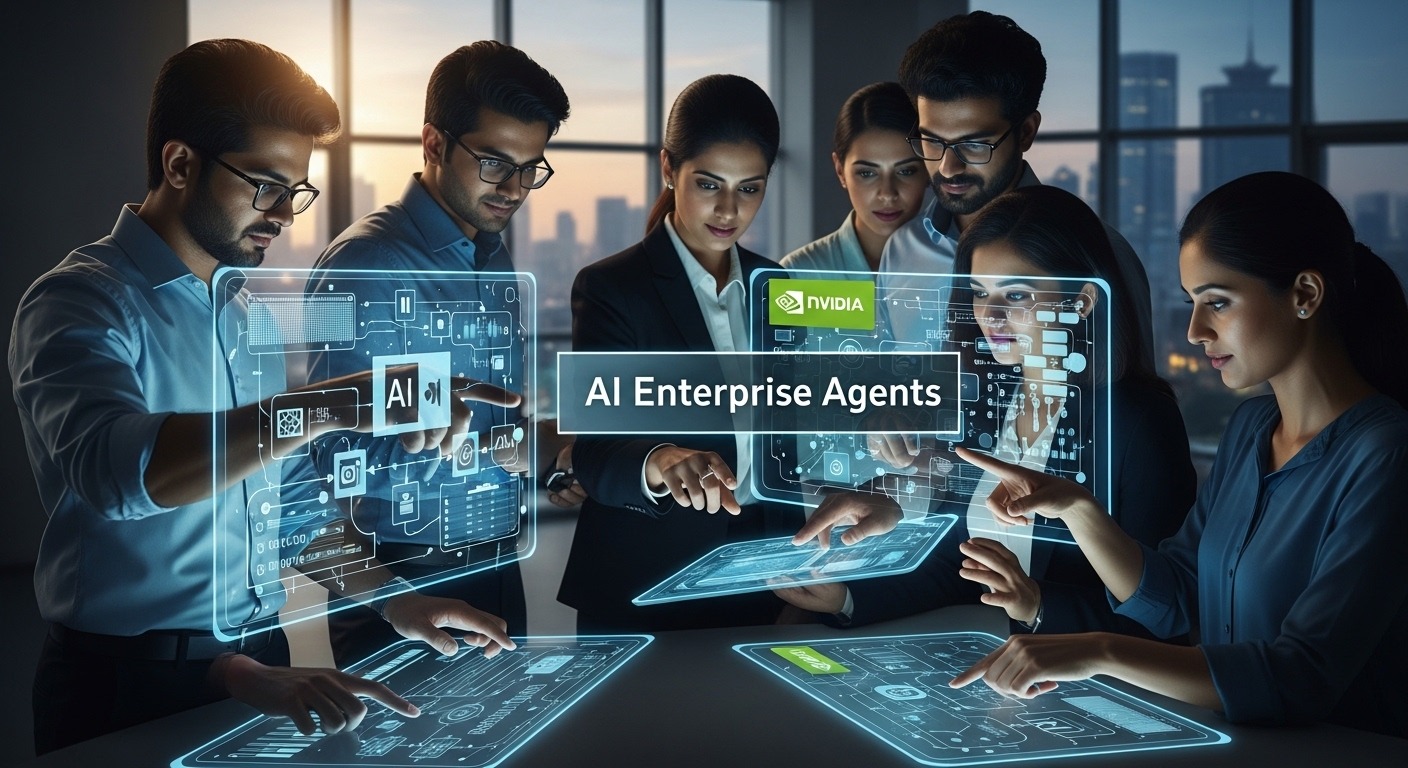
AI Enterprise Agents are changing how businesses run daily work. Many companies now use them to automate routine tasks, reduce errors, and improve decision-making. In India, system integrators are leading this shift by building smart solutions powered by NVIDIA’s AI platforms. These tools help firms move faster and handle growing data without hiring large teams.
India’s strong IT services industry makes it a natural place for innovation. Integrators are combining cloud, data, and AI to create scalable systems. As a result, companies around the world are looking at this model. It shows how automation can improve back-office operations while keeping control and transparency.
What Are AI Enterprise Agents and Why Businesses Need Them
AI Enterprise Agents are intelligent software systems that act like digital workers. They understand requests, analyze data, and complete tasks across business systems. Instead of following fixed rules, they learn from patterns and improve over time.
Today, companies face pressure to do more with fewer resources. Manual work slows growth and increases costs. These agents help solve this challenge by supporting teams and handling repetitive processes.
Before we explore use cases, let’s understand why adoption is growing.
Businesses value these systems because they:
- Reduce time spent on repetitive work
- Improve accuracy and reduce human errors
- Help teams focus on strategic tasks
- Support faster decision-making
- Work across different tools and platforms
This shift is not about replacing people. It is about helping teams work smarter.
India’s Role in Driving AI Enterprise Agents Innovation
India has become a global hub for digital transformation. Large IT services firms and fast-growing startups are building advanced solutions for global clients. These organizations are now focusing strongly on AI Enterprise Agents.
The reason is simple. India already has strong expertise in data, cloud, and software services. Integrators are using this foundation to create new AI-driven automation.
Several factors support this growth:
- Skilled engineers and data professionals
- Strong partnerships with global technology companies
- Growing demand from enterprises worldwide
- Government support for digital innovation
- Experience in large-scale outsourcing and automation
This environment allows integrators to move quickly and deliver scalable solutions.
How NVIDIA AI Supports Next-Gen Automation
NVIDIA provides powerful computing platforms and software that make AI Enterprise Agents more capable. These tools help integrators build systems that can understand language, process documents, and automate workflows.
Instead of building everything from scratch, companies can use NVIDIA’s infrastructure. This reduces development time and improves performance.
Key benefits include:
- Faster model training and deployment
- Real-time processing of large datasets
- Secure and scalable infrastructure
- Tools for natural language and analytics
- Support for enterprise-grade workloads
This approach allows businesses to focus on outcomes rather than technical complexity.
Use Cases Transforming Back Office Operations
The biggest impact of AI Enterprise Agents is in back-office work. These areas often involve high volume and repetitive tasks. Automation improves speed, accuracy, and cost control.
Let’s look at how companies are using these agents today.
Finance and Accounting Automation
Financial processes require precision and compliance. AI agents can review invoices, match payments, and detect unusual activity.
They help teams:
- Automate invoice processing
- Reduce manual data entry
- Identify fraud risks early
- Improve audit readiness
- Support faster reporting
This leads to better financial visibility and stronger compliance.
Customer Support and Service Operations
Customer service teams handle large numbers of requests. Intelligent agents can resolve simple issues and support human teams.
They improve service by:
- Answering common questions
- Routing complex issues to the right expert
- Summarizing customer interactions
- Supporting multilingual communication
- Reducing response times
This improves customer satisfaction and reduces workload.
Human Resources and Employee Support
HR departments manage onboarding, payroll, and employee requests. AI systems help streamline these processes.
Benefits include:
- Faster onboarding workflows
- Automated document processing
- Support for employee queries
- Improved compliance tracking
- Better workforce insights
Employees get quicker support, and HR teams focus on strategy.
Why System Integrators Matter in AI Enterprise Agents Adoption
Technology alone does not create value. Many companies invest in tools but fail to see results because they ignore planning and customization. This is where integrators play a major role in delivering AI Enterprise Agents. They do not only install systems. They design solutions that match real workflows, business goals, and long-term growth.
They also help organizations move from small pilots to full automation. This ensures the technology supports daily operations instead of creating new complexity. As a result, businesses gain faster returns and stronger adoption across teams.
Their role includes:
- Understanding industry challenges
Integrators study each sector before building solutions. This helps them design automation that reflects real needs instead of generic models. - Designing secure architectures
They create systems that protect data, control access, and reduce risk from the start. Security is built into the foundation. - Integrating multiple platforms
Most enterprises use many tools. Integrators connect these systems so automation works across finance, HR, and operations. - Managing data quality
AI works best with clean and accurate data. Integrators set rules and processes to improve reliability and trust. - Supporting long-term scalability
They ensure systems grow with the business. This prevents future disruptions and costly redesign.
Without this expertise, automation projects often fail. Companies may build isolated solutions that cannot scale. Skilled integrators reduce this risk and guide continuous improvement.
Building Trust, Security, and Compliance
Enterprises must protect sensitive data and meet strict regulatory requirements. Security is a key factor in adopting AI Enterprise Agents. Leaders want confidence that automation will not create new risks. Therefore, trust becomes a central part of every project.
Integrators focus on building systems that are transparent and auditable. They design processes where every action can be tracked and reviewed. This supports responsible use and long-term success. It also helps organizations meet global expectations for digital governance.
Important areas include:
- Data protection and encryption
Strong security methods protect business and customer data. Encryption reduces the risk of breaches and supports privacy. - Role-based access control
Only the right people can access critical systems. This limits internal risks and improves accountability. - Monitoring and governance
Continuous tracking ensures systems perform safely and detect unusual activity early. - Compliance with regional laws
Integrators align solutions with regulations in the USA, UK, and other markets. This prevents legal issues and supports global expansion. - Ethical AI practices
Responsible design avoids bias, protects fairness, and builds user confidence.
This structured approach aligns with global standards and builds confidence among stakeholders. As a result, enterprises adopt automation faster while protecting their reputation and customer trust.
Supporting Google E-E-A-T and Modern Digital Strategy
Automation also supports content and digital operations. Companies use AI Enterprise Agents to improve accuracy, clarity, and user experience.
This connects with Google’s E-E-A-T principles. Search engines value real experience and trustworthy information.
These systems help by:
- Keeping data updated
- Improving workflow transparency
- Reducing errors in communication
- Supporting better customer insights
- Enhancing personalization responsibly
This creates stronger digital credibility.
Challenges Businesses Must Understand
Despite the benefits, adoption requires careful planning. Many organizations struggle when they focus only on technology and ignore strategy. Automation is not just about tools. It is about people, processes, and long-term thinking. Companies that rush into projects often face delays, budget issues, or poor results.
Another common problem is resistance from teams. Employees may worry about change if leaders do not explain the purpose clearly. Therefore, communication and training are as important as technology. When teams understand the value, adoption becomes smoother and more successful.
Before launching projects, companies should consider:
- Clear goals and measurable outcomes
Businesses must define what success looks like. This could include cost reduction, faster workflows, or improved customer service. - Strong data quality
Poor data leads to poor results. Organizations should clean, organize, and manage data before automation. - Skilled teams and training
Teams need knowledge to manage and improve AI Enterprise Agents. Continuous learning supports long-term success. - Realistic expectations
Automation takes time. Leaders should focus on gradual improvement rather than instant results. - Continuous monitoring and improvement
Systems must be reviewed regularly. Feedback helps refine processes and improve accuracy.
Avoiding these mistakes protects investment and ensures long-term success. It also builds confidence across leadership and teams.
The Global Impact of India’s AI Enterprise Agents Ecosystem
India’s approach is influencing global markets. Companies in the USA and UK are partnering with Indian integrators to accelerate transformation. These partnerships combine local business understanding with global delivery expertise. As a result, enterprises gain faster innovation and better cost control.
This model is also helping businesses move from traditional outsourcing to intelligent automation. Instead of only handling tasks, Indian providers now deliver strategy, analytics, and digital innovation. This shift is creating new value across industries such as finance, healthcare, and retail.
This model works because it combines:
- Cost efficiency
Businesses reduce operational expenses while improving productivity and accuracy. - Technical expertise
Skilled professionals bring deep knowledge in AI, cloud, and data platforms. - Scalable delivery
Integrators can support both small pilots and large global deployments. - Strong governance
Structured processes improve transparency and reduce risk. - Long-term support
Continuous updates ensure systems stay relevant and secure.
As demand grows, collaboration across regions will increase. This will strengthen innovation and create new global partnerships.
Future Outlook for Enterprise Automation
The future of AI Enterprise Agents will focus on deeper intelligence and autonomy. Systems will move beyond basic automation and support complex decision-making. They will learn from patterns, adapt to change, and guide business strategy.
Organizations will also focus on responsible innovation. They will balance efficiency with transparency, ethics, and user trust. This approach supports sustainable growth and long-term value.
We can expect:
- More proactive automation
Systems will predict issues and take action before problems grow. - Smarter decision support
Leaders will receive insights in real time, helping them respond faster. - Better collaboration between humans and AI
Employees will work alongside intelligent tools, improving productivity and creativity. - Improved data privacy controls
Stronger governance will protect customer and business data. - Faster innovation cycles
Automation will help organizations test and scale new ideas quickly.
Human judgment will remain central. Technology will guide, but people will define goals and values. This balance will shape the future of modern enterprises.
Final Thoughts
AI Enterprise Agents are shaping the next stage of business automation. India’s integrators show how strong partnerships and clear strategy lead to real results. Their work proves that automation can be practical, secure, and scalable across industries.
As enterprises in the USA and UK continue to invest in digital transformation, these solutions will grow. The key is balance. When organizations combine human insight with intelligent systems, they build sustainable growth and stronger trust.



.svg)
.svg)
.svg)
.svg)