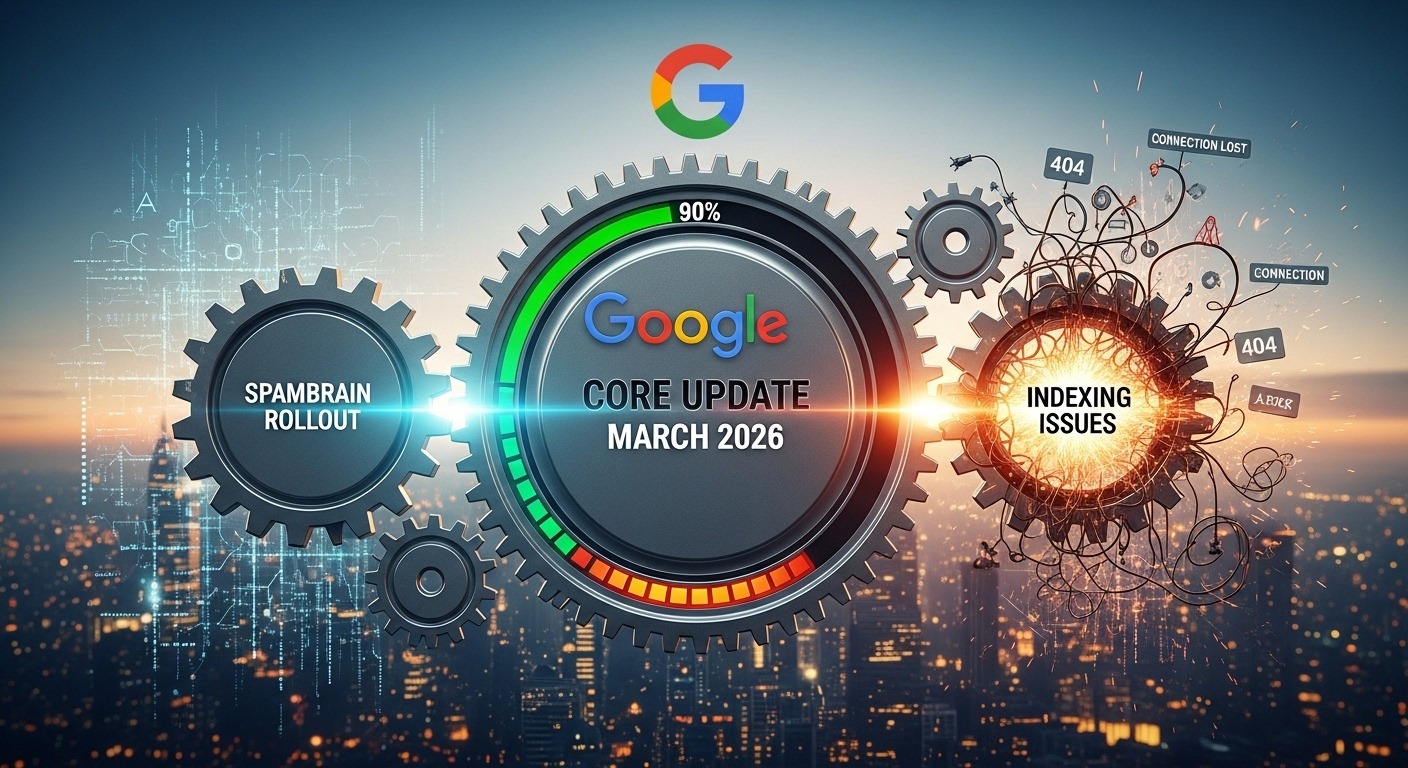
The Google Core Update in March 2026 is one of the biggest search changes in recent years. It is still rolling out in some regions, and many website owners are seeing unstable rankings. Some sites gained traffic, while others lost visibility without warning.

The Google Core Update is not targeting single websites. Instead, it changes how Google understands content quality, trust, and usefulness. This update also connects closely with SpamBrain and new indexing systems that are still not fully stable. In our guide, you will learn what changed, why rankings shifted, and how you can recover safely from the Google Core Update impact.
What is Google Core Update?
The Google Core Update is a major change in Google’s ranking system that affects how websites appear in search results across all industries and countries. It is not a small adjustment but a broad system-wide update that redefines how Google understands content quality and relevance.
Unlike minor updates that focus on one issue, like spam or links, the Google Core Update does not target specific websites, niches, or content types. Instead, it reshapes how Google evaluates all pages together using a much wider set of signals. This means even high-quality websites can see ranking changes if Google’s system finds better alternatives elsewhere.
The Google Core Update usually focuses on several important areas that directly affect search visibility and traffic performance.
Key focus areas include:
- Content quality and depth
- Trust and authority signals
- User experience and satisfaction
- Spam reduction systems
- Content originality and accuracy
- Website reputation across the web
Before moving further, it is important to understand that the Google Core Update is not a penalty system. It does not punish websites directly. Instead, it re-evaluates the entire web and reshuffles rankings based on updated quality understanding.
This means a drop in ranking does not always mean something is wrong. It often means other pages are now considered more useful or more relevant than before.
Key goals of the Google Core Update include:
- Reward helpful, original, and clear content
- Reduce shallow, copied, or low-value pages
- Improve ranking fairness across all websites
- Strengthen trust signals for reliable sources
- Improve matching between search intent and results
- Promote content that fully answers user questions
In simple terms, the Google Core Update tries to make search results more useful by showing the best possible answer, not just the most optimized page.
March 2026 Update Overview
The Google Core Update started rolling out in early March 2026 and is still not fully complete. Google has confirmed that this rollout includes major system-level improvements, especially in spam detection, content evaluation, and indexing behavior.
During this period, many SEO professionals noticed unusual ranking movement across almost all industries. Some pages gained strong visibility quickly, while others dropped even without any changes made to them.
The Google Core Update this year focuses heavily on improving how Google understands content quality and how it reacts to website trust signals in real time.
Key changes in this update include:
- Stronger and deeper content quality checks
- Better spam filtering powered by advanced AI systems
- Indexing delays for weak or low-value pages
- Higher trust requirements for competitive rankings
- Improved detection of repetitive or rewritten content
- More focus on real user satisfaction signals
Before the list below, it is important to understand that ranking volatility is completely normal during a rollout phase. Google systems are still learning and adjusting.
During the Google Core Update, you may notice:
- Search rankings change daily or even hourly
- Some pages temporarily disappear from the results
- Traffic graphs show sudden rises and drops
- Different countries see different ranking behavior
- Similar pages rank differently in different regions
The Google Core Update is still stabilizing, which means the final ranking structure is not fully settled yet. Many sites will continue to adjust until the rollout is officially completed.
SpamBrain Rollout Impact
SpamBrain is one of the most important systems inside the Google Core Update. It is designed to detect spam patterns, low-quality content, and manipulative SEO behavior at scale.
With the 2026 rollout, SpamBrain has become more advanced, faster, and stricter than before. It now uses improved pattern recognition to understand not just obvious spam but also subtle low-quality signals.
The Google Core Update now uses SpamBrain to analyze websites in a deeper and more intelligent way.
SpamBrain focuses on detecting:
- Keyword stuffing and unnatural repetition
- AI-generated spam content with no value
- Unnatural or paid backlink structures
- Duplicate or lightly rewritten content
- Pages created only for ranking without user value
- Low-effort content farms and bulk publishing patterns
What changed after the SpamBrain update:
Before the points below, it is important to understand that SpamBrain is now working almost in real time. It does not wait for manual reviews in most cases.
- Faster detection of spam across newly published pages
- Lower tolerance for weak, thin, or repetitive content
- Stronger penalties for artificial or manipulative linking patterns
- Reduced visibility for low-quality or mass-produced blogs
- Better identification of content that adds no real user value
- More aggressive filtering of pages with poor engagement signals
Because of these changes, many websites experienced sudden ranking drops during the Google Core Update rollout period.
Sites that depend on low-quality content, rewritten articles, or repeated keyword-based pages are the most affected. On the other hand, websites with original, helpful, and well-structured content are seeing more stable or improved performance.
Indexing Issues Continue
One of the biggest concerns during the Google Core Update is indexing instability. Indexing means how Google stores and shows your pages in search results. During this update, many website owners noticed that their pages are not being indexed properly or are taking much longer than normal to appear in search.
Even high-quality and well-written pages sometimes do not appear in search results immediately. This has created confusion because content that should normally rank is staying invisible for days or even weeks.
The Google Core Update has changed how Google decides what to index first. Instead of indexing everything quickly, Google now uses stricter filters to decide which pages deserve priority.
Common indexing problems include:
- New pages not showing in search results
- Old pages are suddenly disappearing from the index
- Delayed updates inside Google Search Console
- Partial indexing, where only some pages are visible
- Pages remain in the “crawled but not indexed” status
- Slow discovery of newly published content
Before the list below, it is important to understand that indexing is now more selective than before. Google is no longer indexing everything at the same speed.
Indexing priority signals now include:
- Trusted websites get faster indexing
- Low-quality or thin pages are ignored
- Duplicate or near-duplicate pages are filtered out
- Content freshness strongly affects indexing speed
- Websites with strong authority get priority crawling
- Pages with a clear structure are easier to index
The Google Core Update is making indexing stricter and more controlled. This change is affecting both new websites trying to grow and older websites that rely on outdated content strategies. In simple terms, Google now prefers fewer but higher-quality pages in its index.
Ranking Signal Changes
The Google Core Update has significantly changed how Google ranks pages in search results. In the past, ranking was heavily influenced by keywords and backlinks. Now, the system is much smarter and focuses more on real user value and satisfaction.
This means a page must not only include keywords but also clearly solve a problem, answer a question, or simply provide helpful information.
Key ranking signals include:
- Content clarity and structure
- Real usefulness for readers
- Engagement, such as time spent on the page
- Trust and authority signals from the website
- Content depth and topic coverage
- User satisfaction after visiting the page
Before the list below, it is important to understand that Google is actively reducing the impact of old SEO tricks that were once used to manipulate rankings.
Old SEO practices are losing power:
- Natural writing is now rewarded more than keyword stuffing
- Clickbait titles and misleading content lose rankings
- Repetitive or low-value pages are filtered out
- Expert and experience-based content gets higher visibility
- Thin articles with little detail are no longer effective
- Over-optimized pages may see ranking drops
The Google Core Update strongly prefers content that answers real user questions in a clear, direct, and complete way. Pages that fully solve a topic are now more likely to rank higher than pages that only partially cover it.
Website Impact and Traffic Changes
The Google Core Update has caused major traffic changes across many websites. Some sites experienced growth, while others saw significant drops in organic traffic, sometimes up to 50% or more.
These changes did not happen evenly. Different industries and content types were affected in different ways depending on how Google evaluates trust and quality in each niche.
Most affected niches include:
- Health and medical blogs
- Finance and investment websites
- News and trending content platforms
- Affiliate marketing and review pages
- Low-authority informational blogs
The Google Core Update evaluates trust much more strictly in these areas because incorrect or low-quality information can harm users.
Common traffic effects include:
Before the list below, it is important to understand that these changes are not always permanent. Many websites recover after improving content quality.
- Sudden drop in organic search traffic
- Temporary or permanent ranking loss for key pages
- Keyword position fluctuations across SERPs
- Uneven performance where some pages rank well, and others do not
- Loss of visibility for older, outdated content
- Strong competition from higher-quality pages
The Google Core Update clearly shows that content quality now matters more than content quantity. Websites that publish many low-value pages are losing visibility, while websites that focus on fewer but more helpful pages are performing better in search results.
Recovery Steps After Update Impact
Recovering from the Google Core Update is not something that happens quickly. It requires patience, steady improvement, and a clear focus on content quality. Many websites try to fix rankings fast, but there is no instant solution or shortcut that works in this situation.
Google clearly prefers long-term improvements instead of quick changes. This means websites that slowly improve their content, structure, and trust signals are more likely to recover over time. Sudden or aggressive SEO changes usually do not help.
The Google Core Update rewards websites that fix real problems instead of trying to manipulate rankings.
Effective recovery actions include:
Before the list below, remember that recovery is mainly about improving real value for users, not just SEO adjustments.
- Improve article depth by adding more useful explanations and examples
- Remove low-quality, outdated, or thin content that adds no value
- Fix internal linking so pages connect in a clear and helpful way
- Add real-world examples to make content easier to understand
- Update old content with fresh data, facts, and improved structure
- Improve page readability so users can understand information quickly
The Google Core Update rewards websites that focus on helpful, honest, and complete content updates. Pages that clearly solve user problems tend to recover faster than pages that are only optimized for keywords.
Websites that improve slowly but consistently usually perform better in the long run. Google values steady growth in quality more than sudden SEO changes.
SEO Strategies After Google Core Update
To perform well after the Google Core Update, websites need to follow simple, clean, and user-focused SEO strategies. The focus is no longer on tricks or shortcuts but on creating real value for readers.
Google is now strongly focused on content usefulness, clarity, and user satisfaction. This means websites must prioritize people over search engine tactics.
The Google Core Update has reduced the effectiveness of outdated SEO methods and increased the importance of natural, helpful writing.
Best SEO strategies include:
Before the list below, remember that simplicity and clarity now win in search rankings.
- Focus on writing content for real people first, not for search engines.
- Keep sentences and paragraphs short for better readability
- Avoid repeating keywords in an unnatural or forced way
- Cover topics in full depth so users do not need extra searches
- Improve structure using clear headings and logical flow
- Focus on answering user questions directly and clearly
- Use natural language instead of robotic SEO writing
The Google Core Update is designed to reduce spammy SEO methods and improve overall search quality. Websites that try to manipulate rankings often lose visibility, while websites that focus on clarity and usefulness gain trust over time.
Content Quality Guidelines in 2026 Update
The Google Core Update places a very strong focus on content quality. In 2026, Google is better at understanding whether content is actually helpful or just created to rank in search engines.
Websites that publish clear, useful, and original content are more likely to perform well. On the other hand, low-effort or repetitive content is being filtered out more aggressively. The Google Core Update is shifting SEO toward real value instead of keyword-heavy writing.
What Google prefers now:
- Simple and direct answers that users can understand easily
- Original ideas, personal insights, or unique explanations
- Clear writing without confusion or unnecessary complexity
- Updated and accurate information that matches current facts
- Complete topic coverage that fully explains the subject
What Google avoids:
- Repeated keyword-heavy content with no real value
- Thin or shallow articles that lack detail
- Misleading or unclear information that confuses users
- Over-optimized pages written only for search engines
- Content that does not fully answer user intent
Before listing below, understand that quality is now the most important ranking factor in the Google Core Update.
Core writing principles for better ranking:
- Write based on user intent and real questions
- Add practical examples to improve understanding
- Avoid filler sentences that do not add value
- Focus on covering the topic completely from start to end
- Make content easy to read, scan, and understand quickly
The Google Core Update strongly rewards content that solves real user problems clearly and directly. Websites that focus on helping users instead of chasing rankings are the ones that perform best in the long term.
Comparison Table: Pre vs. Post-Update Behavior
The Google Core Update has significantly changed how search results behave. Earlier systems were more dependent on keywords and basic SEO signals. Now, Google uses an advanced understanding of user intent, content quality, and trust signals.
This shift has changed how websites rank, index, and compete in search results. Below is a clearer comparison of how things worked before and how they work after the update.
The Google Core Update clearly shows a shift toward smarter, more human-like search evaluation. Instead of simply matching words, Google now tries to understand meaning, usefulness, and trustworthiness. This makes search results more accurate but also more competitive for website owners.
SEO Checklist for Website Owners
This checklist is designed to help website owners adapt safely and effectively after the Google Core Update. It focuses on long-term improvements rather than quick SEO tricks. The goal is simple: build a website that Google and users both trust.
Before the list below, remember that small improvements done consistently can lead to strong long-term ranking recovery.
Core SEO improvement checklist:
- Improve content clarity by rewriting confusing or weak sections so users understand information quickly
- Remove duplicate pages that compete with each other and reduce overall site quality signals
- Fix broken internal and external links to improve user experience and site structure
- Update old posts regularly with new data, better examples, and improved explanations
- Improve mobile usability so pages load and display correctly on all devices
- Optimize page speed to reduce user drop-off and improve engagement signals
- Monitor traffic weekly to identify sudden drops or growth patterns early
- Strengthen internal linking so important pages are easier for Google to discover
- Add helpful visuals or examples to improve understanding of complex topics
- Remove or merge thin content pages that do not provide real value
The Google Core Update rewards websites that continuously improve their content instead of making one-time changes. Google now looks for consistency, not shortcuts. Websites that regularly update, refine, and improve their content tend to recover faster and maintain stronger rankings over time. On the other hand, websites that ignore quality issues or rely only on SEO tricks often struggle to regain visibility.
In simple terms, the Google Core Update is pushing all websites toward one direction: better content, better user experience, and long-term trust building.
Final Thoughts
The Google Core Update in March 2026 is still influencing search results, and rankings are expected to keep fluctuating over the coming weeks as the system continues to stabilize. Many websites are still experiencing noticeable movement during this adjustment period.
This update highlights Google’s increasing focus on quality, trust, and usefulness. Websites that consistently provide genuine value are more likely to perform well in the long run. Ultimately, success comes from patience, consistency, and authentic content. Rather than fearing the Google Core Update, it should be understood and adapted step by step.



.svg)
.svg)
.svg)
.svg)