Generative UI is transforming how people interact with websites, apps, and digital platforms. Instead of fixed screens and rigid layouts, systems now create visual and interactive experiences based on user intent. This shift allows businesses to move from static design toward flexible and adaptive digital journeys that respond to every user.
Organizations in the USA and UK are investing in Generative UI to improve engagement, conversion, and personalization. From SaaS platforms to eCommerce, companies want experiences that feel natural and responsive. Our guide explains how this technology works, why it matters, and how businesses can use it to stay competitive in modern digital markets.
What Is Generative UI and Why It Matters
Generative UI refers to interfaces that are created dynamically based on prompts, behavior, or context. Instead of using templates, systems build layouts, visuals, and workflows in real time. This creates highly personalized experiences that match user goals.
This approach matters because users expect relevance. They want faster decisions, smoother journeys, and clear guidance. Static interfaces often fail to deliver this. Dynamic systems improve satisfaction and trust.
Before exploring advanced use cases, let us look at the core advantages:
Deep personalization: Interfaces adapt to user intent, past behavior, and real-time context.
Reduced friction in navigation: Users do not need to search through menus. The system guides them.
Faster product discovery: Relevant content appears at the right time.
Improved decision-making: Visual and interactive guidance helps users act with confidence.
Better accessibility support: Layouts adjust for different needs and devices.
Global user adaptability: Interfaces change based on region, language, and culture.
Because of these strengths, businesses see this as the next evolution in digital design.
How Generative UI Works Behind the Scenes
To fully understand Generative UI, it is useful to break down how these systems function. They combine language understanding, visual design, and behavioral insights. Instead of following fixed rules, these systems respond to user needs in real time. This makes digital experiences more flexible, intuitive, and user-focused.
When a user enters a prompt or takes an action, the system first interprets intent. It looks at the words, context, past behavior, and even device type. After that, it generates layouts, images, forms, or workflows that match the goal. This happens instantly, which allows users to see results without delay. The final experience feels natural because the interface adapts as the user continues interacting.
Another important part is context awareness. The system does not only respond to a single input. It also learns from earlier actions during the same session. For example, if a user is comparing products, the interface can adjust recommendations, visuals, and navigation. This improves clarity and reduces effort.
Key Components of Generative UI Systems
Each platform depends on several layers that work together to create meaningful experiences. These components ensure that the interface remains useful, relevant, and engaging.
Prompt and context analysis Systems interpret language, user behavior, history, and goals to understand intent clearly.
Design and layout creation Visual components such as cards, dashboards, and interactive elements are generated automatically based on user needs.
Interaction generation Buttons, forms, menus, and navigation flows appear dynamically to guide users toward outcomes.
Real-time personalization Content changes continuously during the session, helping users move faster and make better decisions.
Learning and feedback loops Systems improve over time by analyzing interactions, results, and user satisfaction.
Multimodal understanding These platforms combine text, voice, images, and gestures to create richer experiences.
Performance optimization Systems monitor speed and usability to ensure smooth interactions across devices.
Security and privacy controls Responsible systems protect user data while delivering personalization.
This process ensures that every experience feels unique, relevant, and responsive. Over time, this adaptive approach builds trust, improves engagement, and supports long-term digital growth.
Traditional UI vs Generative UI
Most digital products still use fixed design frameworks. These systems rely on predefined layouts and user journeys. While this worked in the past, modern users expect personalized and responsive experiences. Comparing both approaches helps clarify why many organizations are shifting toward Generative UI.
Feature
Traditional UI
Generative UI
Structure
Fixed layouts that remain the same for all users
Adaptive layouts that change based on user needs
Personalization
Limited and rule-based
Deep, contextual, and real-time
Speed
Slow updates that require manual design changes
Real-time evolution during interaction
Flexibility
Restricted and hard to scale
Highly scalable and flexible
User Control
Low, users follow predefined paths
High, users shape the experience
Engagement
Standard and predictable
Interactive and immersive
Traditional interfaces depend on designers to predict user behavior in advance. As a result, they often struggle to match real user intent. In contrast, Generative UI responds instantly to changing needs. It adapts layouts, visuals, and workflows as users explore and interact.
This shift is similar to the move from static websites to dynamic platforms. Earlier, websites displayed the same content to every visitor. Today, content adapts based on context and behavior. Now, this transformation is extending to the entire user journey, from discovery to decision-making.
Because of this change, businesses can create more meaningful digital experiences. Instead of forcing users to adjust, platforms evolve around user goals. Over time, this leads to stronger engagement, better trust, and higher conversions.
Key Use Cases Across Industries
Businesses across the USA and UK are testing Generative UI in real environments. Each sector applies it uniquely based on customer needs, goals, and digital maturity. As a result, companies are discovering new opportunities to improve engagement, simplify journeys, and deliver more relevant experiences.
1. eCommerce and Retail
Retailers use dynamic interfaces to increase conversions and customer satisfaction. Instead of showing the same product pages to every visitor, systems now adapt in real time based on user intent, browsing behavior, and preferences. This helps shoppers find the right products faster.
Personalized product discovery
Adaptive homepages
Visual product customization
Smart recommendations
Dynamic pricing insights
Interactive shopping journeys
Guided checkout processes
Real-time product comparisons
Context-based promotions
This reduces decision fatigue, improves confidence, and increases trust during the buying journey.
2. SaaS and Enterprise Platforms
Software companies use Generative UI to simplify workflows and improve productivity. Many users struggle with complex tools and static dashboards. Dynamic systems remove this friction by presenting only the most relevant data and features.
Custom dashboards
Context-aware analytics
Guided onboarding
Automated reporting
Smart navigation
Adaptive workflows
Real-time collaboration tools
Personalized task recommendations
Dynamic role-based interfaces
As a result, users spend less time learning systems and more time achieving meaningful outcomes.
3. Education and Training
Learning platforms benefit from personalized and adaptive content. Instead of following a fixed curriculum, students receive tailored experiences that match their pace and learning style. This supports both academic and professional development.
Dynamic lesson plans
Visual learning tools
Adaptive quizzes
Personalized progress tracking
Interactive simulations
Context-based feedback
Custom skill pathways
Real-time learning insights
Motivational and gamified elements
This improves engagement, understanding, and long-term retention.
4. Healthcare and Support
Healthcare platforms create guided and clear experiences to reduce stress and confusion. Patients often struggle with complex processes. Dynamic interfaces simplify these steps and provide better clarity.
Symptom and diagnosis tools
Personalized health dashboards
Adaptive forms
Smart scheduling
Interactive education
Patient engagement systems
Remote monitoring dashboards
Guided treatment journeys
Context-based reminders
These features reduce errors, improve communication, and help users feel more confident about their care.
Why the USA and UK Markets Are Leading Adoption
Companies in these regions place a strong emphasis on innovation and data-driven decision-making. As a result, Generative UI adoption is growing rapidly across industries such as finance, SaaS, retail, and healthcare. Businesses in the USA and the UK also face intense competition, which pushes them to deliver better, more personalized digital experiences.
Another key reason is customer expectations. Users in these markets demand speed, relevance, and smooth journeys. Static interfaces often fail to meet these standards. Therefore, organizations are investing in adaptive and intelligent systems that improve engagement and trust.
Key reasons include:
Mature digital ecosystems Strong cloud, AI, and data infrastructure support rapid experimentation and scaling.
Strong competition and user expectations Businesses must innovate constantly to stay relevant in fast-moving markets.
High investment in AI and design Companies allocate large budgets to research, automation, and user experience.
Focus on personalization and trust Organizations aim to deliver tailored journeys while protecting user privacy.
Regulatory awareness and governance Strict rules encourage responsible and transparent technology adoption.
Skilled workforce and research culture Access to talent helps companies build and test advanced solutions.
Demand for scalable customer experiences Businesses need systems that serve millions of users without losing relevance.
These factors encourage early adoption, structured experimentation, and long-term investment in Generative UI.
Benefits of Generative UI for Businesses
The business value of Generative UI becomes clear when organizations scale operations. This approach improves both efficiency and customer engagement. Instead of relying on fixed systems, companies can adapt experiences based on real-time user intent.
Before exploring the full list, it is important to remember that success depends on strong strategy, governance, and data quality. Technology alone does not guarantee results.
Higher conversion and retention Personalized journeys reduce friction and help users make confident decisions.
Lower design and development costs Automation reduces repetitive tasks and shortens product cycles.
Better customer insights Real-time data reveals user behavior, preferences, and challenges.
Faster product innovation Teams can test, learn, and improve quickly without large redesign efforts.
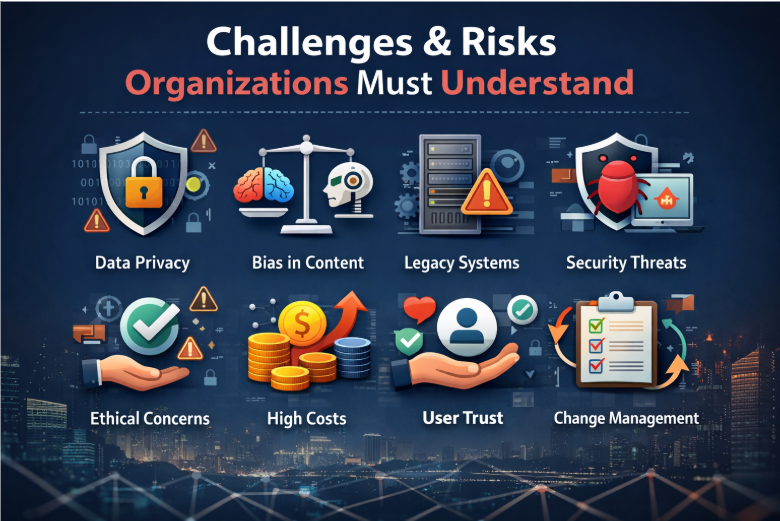
Challenges and Risks Organizations Must Understand
Adopting Generative UI also brings risks. While the benefits are strong, companies must manage these challenges carefully to protect users, reputation, and long-term growth. Many organizations struggle when they move too fast without clear governance or strong data foundations. As a result, early planning becomes essential.
Another important point is trust. Users expect personalization, but they also want control over their data. Businesses must balance innovation with privacy and transparency. This balance builds credibility and supports sustainable adoption.
Common Challenges
Data privacy and compliance Companies must follow regulations such as data protection laws and industry standards. This requires secure systems and clear user consent.
Ethical design and transparency Users should understand how decisions and recommendations are generated. Clear communication builds confidence.
Bias in generated content Poor data or weak models can create unfair or misleading experiences. Regular monitoring helps reduce risk.
Integration with legacy systems Many organizations rely on older platforms. Connecting them with modern adaptive systems can be complex.
Security concerns Dynamic systems must protect sensitive data and prevent misuse.
User trust and control People want to control personalization and data usage. Providing clear settings improves trust.
Cost of transformation Initial investment in tools, talent, and infrastructure can be high.
Change management Teams must learn new workflows and adapt to continuous innovation.
Organizations that plan early, invest in governance, and build strong data practices reduce risk and improve outcomes.
Best Practices for Successful Implementation
Companies that succeed with Generative UI follow structured and responsible strategies. Instead of rushing adoption, they focus on long-term value, user trust, and measurable outcomes. This approach supports stability and sustainable growth.
Before scaling, they focus on strong foundations and clear priorities.
Define clear goals Focus on solving real user problems and improving measurable results.
Align technology with business needs Ensure that solutions support strategy, not just innovation for its own sake.
Start with pilot projects Test small use cases before expanding across the organization.
Focus on high-value opportunities Prioritize areas that improve engagement, efficiency, or revenue.
Build cross-functional teams Collaboration between design, data, product, and compliance teams ensures better outcomes.
Improve data quality Clean, reliable, and relevant data improves accuracy and performance.
Train designers and developers Skills in adaptive design and responsible AI reduce risk.
Monitor user feedback continuously Real-world insights help improve systems and prevent mistakes.
Create governance and ethical standards Clear policies protect users and support responsible innovation.
Build transparency and explainability Users should understand how experiences are generated and why.
Measure performance and impact Continuous testing ensures long-term value and improvement.
These steps improve stability, reduce risk, and help organizations unlock the full potential of Generative UI while maintaining trust and accountability.
How Generative UI Supports Personalization and User Intent
Understanding intent is now central to digital success. Generative UI enables real-time personalization at scale by interpreting what users want and adjusting experiences instantly. Instead of using static paths, platforms respond to behavior, context, and goals. This creates smoother and more meaningful journeys.
Instead of forcing users into predefined journeys, systems adapt continuously. As users explore, the interface evolves. This reduces confusion, saves time, and improves decision-making. Over time, this approach builds trust because users feel understood and supported.
Examples include:
Travel platforms creating dynamic trip plans Interfaces generate itineraries, maps, and suggestions based on budget, timing, and preferences.
Finance apps generating dashboards Users see insights that match their goals, such as saving, investing, or budgeting.
Learning systems build personalized pathways Content adapts to pace, skill level, and learning style.
Healthcare portals guiding next steps Patients receive clear and relevant information based on their needs.
Customer support platforms offering smart guidance Dynamic workflows help users solve problems faster.
This approach improves engagement, satisfaction, and long-term loyalty.
The Role of Human Judgment in Generative UI
Technology enhances productivity, but human thinking remains essential. Strategy, ethics, and creativity depend on people. While automation handles complexity, human judgment ensures that experiences remain meaningful, fair, and responsible.
Organizations must balance innovation with control. Human oversight protects users, ensures compliance, and guides long-term value. Without this balance, systems may create confusion or bias.
Human roles include:
Setting business direction Leaders define goals, priorities, and success metrics.
Designing meaningful experiences Designers ensure clarity, usability, and emotional connection.
Ensuring accessibility Experts make sure systems work for diverse users and devices.
Protecting user trust Clear communication and ethical practices build confidence.
Defining boundaries Policies guide safe and responsible automation.
Evaluating outcomes Continuous review improves quality and reduces risk.
Maintaining accountability Human responsibility ensures transparency and governance.
Encouraging innovation with purpose Teams focus on real value instead of technology alone.
When humans guide systems, Generative UI delivers sustainable and long-term value.
Future Trends Shaping Generative UI
The future of digital interaction will become more immersive, adaptive, and intuitive. As technology evolves, users will expect faster, richer, and more natural experiences. Organizations must prepare early to stay competitive.
Key trends include:
Multimodal interfaces Platforms will combine text, voice, images, and gestures to create seamless experiences.
Voice-driven interactions Conversational interfaces will simplify complex tasks.
Visual and spatial computing Augmented and immersive environments will support decision-making.
Predictive and proactive journeys Systems will anticipate needs and suggest actions.
Real-time collaboration Teams and users will interact dynamically across platforms.
Integration with emerging technologies Connections with AI, automation, and analytics will grow.
Stronger privacy and trust frameworks Transparency and control will become central.
Decentralized user control Users will manage their data and preferences more directly.
Continuous learning systems Platforms will improve automatically through feedback.
These trends will redefine digital engagement and create new opportunities for businesses and users alike.
Impact on SEO, Digital Marketing, and Web Design
Digital marketing will change significantly as Generative UI becomes more common. This shift is not only about design. It affects how users search, discover, and interact with content. Search engines are already rewarding relevance, clarity, and strong user experience. Adaptive interfaces support these goals by delivering personalized and useful journeys.
Another major change is the move from static content to interactive experiences. Instead of showing the same page to every visitor, brands can present tailored layouts based on intent, behavior, and context. This improves engagement and helps users find solutions faster.
Marketers must focus on:
Intent-driven search experiences Content and interfaces should match real user needs, not just keywords.
Dynamic content Pages update in real time based on location, behavior, and goals.
Real-time personalization Visitors receive relevant offers and information during the session.
Context-based targeting Campaigns align with user journeys across channels.
Trust and transparency Clear messaging and ethical personalization build long-term loyalty.
High-quality user journeys Smooth navigation and helpful guidance improve satisfaction and rankings.
Data-driven decision making Real-time insights help marketers optimize campaigns quickly.
Stronger alignment with search intent Adaptive systems match how modern algorithms evaluate quality.
This approach aligns with modern search expectations, especially in competitive markets like the USA and UK.
How to Prepare Your Business for Generative UI
Preparation helps companies stay competitive and resilient in a rapidly changing digital landscape. Organizations that start early gain a strong advantage because they build the right skills, data, and systems before competitors.
Another important factor is culture. Businesses must encourage experimentation, collaboration, and continuous learning. This mindset supports innovation and reduces resistance to change.
Key actions:
Audit user journeys Identify friction points and opportunities for improvement.
Identify automation opportunities Focus on areas where adaptive systems can create real value.
Invest in talent and training Develop skills in design, data, and user experience.
Strengthen data infrastructure Reliable data improves personalization and decision-making.
Focus on user trust Clear privacy and transparency policies build credibility.
Build flexible digital platforms Modern architecture supports scalability and innovation.
Test and measure results Continuous testing helps improve performance and reduce risk.
Collaborate across teams Alignment between marketing, design, and technology drives success.
Start with small pilots Learning from small projects reduces complexity and cost.
Create a long-term strategy and governance Clear direction ensures sustainable growth and responsible innovation.
These steps create long-term readiness and help organizations unlock the full value of Generative UI while maintaining trust and stability.
Comparison of Key Tools Supporting Generative UI
As Generative UI grows, many tools and platforms are emerging to support adaptive design, personalization, and automation. However, not every solution fits every business. Companies must evaluate their goals, technical maturity, and long-term strategy before selecting the right approach. Some tools focus on design and visuals, while others support data, automation, or real-time personalization.
The table below highlights the main platform categories and how they support modern digital experiences.
Platform Type
Focus
Best For
AI design tools
Automated layout creation, visual generation, and rapid prototyping
Startups and design teams
Personalization engines
Adaptive user journeys, recommendations, and targeted experiences
Retail and eCommerce
Data platforms
Real-time insights, behavioral analytics, and predictive modeling
Large enterprises
Low-code systems
Fast development, flexibility, and reduced technical complexity
SMBs and growing businesses
Automation tools
Workflow optimization, process efficiency, and operational support
Operations and service teams
Each category plays a different role in building a strong Generative UI ecosystem. For example, startups often begin with AI design tools to move quickly. Retail businesses focus on personalization engines to improve customer engagement. Enterprises invest in data platforms to support large-scale decision-making.
It is also important to consider integration. Many organizations combine multiple tools to create flexible and scalable solutions. This layered approach allows businesses to adapt over time without rebuilding systems.
Selecting the right tools depends on business maturity, budget, and long-term goals. Companies that align technology with strategy can build adaptive experiences that support growth, innovation, and competitive advantage.
Final Thoughts
Generative UI is shaping the future of digital experiences. It allows businesses to create flexible, responsive, and meaningful interactions that align with user intent. Organizations that invest in this approach can improve engagement, efficiency, and innovation while building stronger relationships with customers.
Long-term success requires thoughtful strategy, strong governance, and human judgment. When technology and purpose work together, Generative UI becomes a powerful foundation for growth, trust, and competitive advantage in the USA and UK markets.
Have a project in mind?
Schedule a discovery call today to discuss things in more depth.





.svg)
.svg)
.svg)
.svg)