Compliance Rules shape how financial websites operate, communicate, and earn trust. From global banks to private funds, every financial brand that collects data or promotes services online must follow clear legal and ethical standards. These rules protect users, reduce risk, and help firms avoid costly penalties.

Financial websites are under more scrutiny than most. Regulators expect accuracy, fairness, and transparency at every step. When Compliance Rules are followed correctly, websites become safer, clearer, and more reliable for users and regulators alike.
Why Compliance Rules Matter for Financial Websites
Compliance Rules are not optional for financial platforms. They exist to protect investors, customers, and institutions from harm. Regulators focus heavily on online activity because websites often serve as the first point of contact.
Financial firms face higher expectations because they handle money, personal data, and sensitive decisions. Even small mistakes can lead to fines or reputational damage. Before listing requirements, it is important to understand what compliance achieves:
- Protects users from misleading information
- Prevents data misuse and breaches
- Builds long-term trust
- Reduces legal and financial risk
When rules are built into website design and content, compliance becomes part of daily operations rather than a last-minute fix.
Who Must Follow Compliance Rules
Compliance Rules apply to every financial organization that uses a website to communicate, attract clients, or share information. The level of responsibility may differ, but the obligation to be accurate, fair, and transparent remains the same. Regulators expect financial websites to protect users, avoid confusion, and present information honestly.
Below is a clear breakdown of how these rules affect different financial entities and what each must handle carefully.
General Partners (GPs)
General Partner websites often serve as a gateway for investors. These sites promote funds, outline strategies, and collect interest through forms or private portals. Because of this, Compliance Rules require a high level of care in both language and access control.
GPs must ensure that every claim reflects reality and that sensitive information stays protected. Even minor wording choices can create legal risk if they suggest certainty or obscure downside risks.
GPs must ensure that:
- Performance claims are factual
Past performance must be shown with context and without selective data. Any figures should be accurate and complete. - Investor-only content is gated
Detailed fund documents, reports, and projections should only be available to qualified users through controlled access. - Risk language is clear and visible
Risks should appear near performance discussions, not hidden in footers or separate pages.
When these rules are followed properly, GP websites build trust and reduce regulator scrutiny.
Venture Capital Firms (VCs)
Venture capital websites often use a relaxed tone and storytelling. While this style helps branding, it does not remove regulatory responsibility. Compliance Rules still apply when VCs discuss portfolio growth, fundraising activity, or expected outcomes.
VC firms must balance clarity with caution. Casual language can still mislead if it implies guaranteed success.
VC firms must:
- Avoid exaggerated success claims
Highlighting wins is allowed, but failures and risks should not be ignored or minimized. - Clarify forward-looking statements
Any mention of plans or expectations must be clearly framed as uncertain and subject to change. - Protect founder and investor data
Contact forms, pitch submissions, and email lists must follow data protection standards.
Strict rules help VC firms stay credible while maintaining a modern web presence.
Funds and Asset Managers
Funds and asset managers face some of the most demanding Compliance Rules because their websites often combine marketing, legal disclosure, and investor access. These platforms may host fund details, reports, and performance summaries.
Accuracy and freshness matter here. Outdated or unclear information creates immediate risk.
Key expectations include:
- Clear risk disclosures
Risks must be explained in simple language and placed where users can easily see them. - Updated legal documents
Offering materials, terms, and disclosures should reflect current rules and fund status. - Secure data handling
Investor portals and forms must protect sensitive information at all times.
Funds that follow these rules consistently show professionalism and reliability to both users and regulators.
Banks and Financial Institutions
Banks operate under layered oversight and public trust. Their websites support daily user actions such as account access, payments, and product comparisons. Because of this, Compliance Rules apply across public pages, private dashboards, and digital marketing content.
Banks must ensure that information is easy to understand and equally accessible to all users.
Banks must ensure:
- Strong security standards
User data and transactions must remain protected through reliable technical safeguards. - Clear fee and product explanations
Charges, limits, and conditions must be explained upfront without confusion. - Fair and accessible communication
Content should be readable, inclusive, and usable by people with different needs.
For banks, Rules are not just legal duties. They are part of maintaining public confidence.
Core Compliance Rules Every Financial Website Must Follow
Compliance Rules form the foundation of every trustworthy financial website. These rules guide how information is written, displayed, and protected. Regulators do not judge intent. They judge clarity, accuracy, and fairness. When websites fail here, penalties follow.
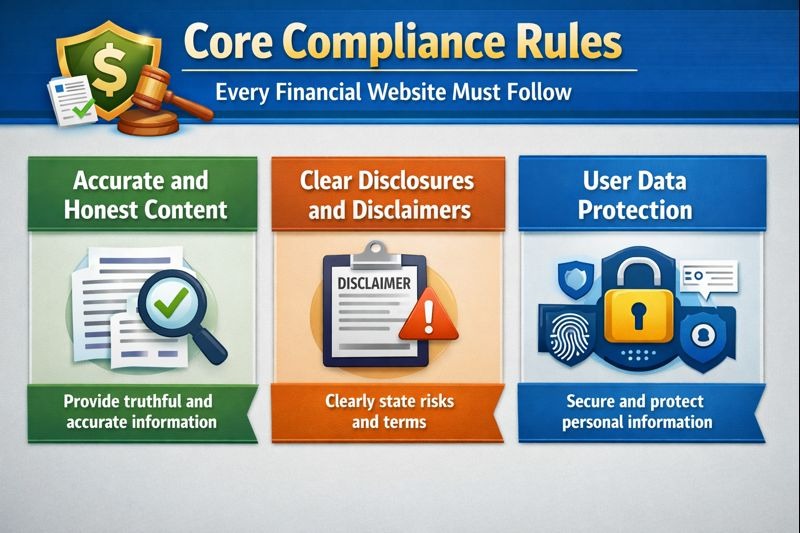
Each rule below applies across all financial entities, regardless of size or location.
Accurate and Honest Content
Financial websites must present information that is factual, balanced, and complete. Compliance Rules do not allow selective storytelling or vague promises. Every benefit must be shown alongside its limits.
Regulators review not only what is said, but how it is said. Tone, placement, and wording matter just as much as facts.
Key requirements include:
- No misleading claims
Statements must reflect reality. Avoid language that suggests certainty or guaranteed outcomes. - No hidden disclaimers
Important limits and risks must appear near related claims, not buried in footers or separate pages. - Clear explanation of risks
Risks should be written in simple language that an average reader can understand.
Honest content builds trust and lowers regulatory risk.
Clear Disclosures and Disclaimers
Disclosures explain the legal and financial context behind what users read. Compliance Rules require disclosures to be visible, readable, and meaningful. Long blocks of legal text weaken compliance rather than strengthen it.
Disclosures should guide understanding, not discourage reading.
Good disclosure practices include:
- Plain language
Use clear words. Avoid complex sentences or unnecessary legal terms. - Easy-to-find placement
Place disclosures close to performance data, pricing, or promotional content. - No legal clutter
Only include information that users need to understand risks and limits.
Strong disclosures protect both users and institutions.
User Data Protection
Financial websites often collect sensitive personal and financial information. Compliance Rules demand strict handling of all user data from the moment it is collected.
Data protection is not only a technical issue. It is also a trust issue.
Key expectations include:
- Secure data storage
User information must be protected from unauthorized access at all times. - Transparent data usage
Users should know what data is collected and why. - User consent before collection
Consent must be clear and given before collecting non-essential data.
Good data practices reduce risk and improve user confidence.
Regional Compliance Rules: US and UK Focus
While many Compliance Rules overlap globally, regional expectations still matter. Financial websites must reflect the standards of the markets they serve.
United States Requirements
In the United States, Compliance Rules are enforced by multiple oversight bodies. Financial websites must prioritize investor protection, truthful marketing, and data security.
US regulators pay close attention to how financial products are promoted online.
Common expectations include:
- Clear marketing boundaries
Educational content must not appear as personalized financial advice. - Risk statements for investments
Investment risks must be stated clearly wherever returns are discussed. - Secure handling of personal data
User information must be collected and stored responsibly.
Failure to meet these standards can trigger investigations or penalties.
United Kingdom Requirements
UK regulators place strong emphasis on fairness and user understanding. Compliance Rules in the UK focus on helping users make informed decisions without pressure or confusion.
Clarity matters more than volume.
UK-focused expectations include:
- Balanced messaging
Benefits and risks must receive equal attention. - Transparent pricing
Fees, charges, and conditions should be easy to understand. - Accessible disclosures
Information must be readable and usable by a wide range of users.
UK compliance rewards simplicity and honesty.
Cookie Consent and Privacy Compliance
Privacy sits at the core of modern Compliance Rules, especially for financial websites. These platforms collect personal details, track user behavior, and often handle sensitive financial information. Because of this, regulators expect more than written promises. They expect clear actions that protect users in real time.
Financial websites must clearly explain what data is collected, why it is collected, and how long it is kept. This information should be easy to find and written in plain language. Hiding details in long legal text increases risk and weakens trust.
Before listing steps, it is important to understand one point: regulators look at behavior, not intention. A privacy page alone is not enough. The website must actively respect user choices.
Best practices include:
- Cookie consent banners
Banners should appear on the first visit and explain cookie use clearly. Users must be able to accept, reject, or manage cookies without pressure. - Clear privacy policies
Policies should explain data collection, storage, and sharing in simple terms. Updates must reflect current website behavior, not outdated setups. - Easy opt-out options
Users should be able to withdraw consent without confusion. Opt-out links should work instantly and remain visible.
Strong privacy compliance shows respect for users and keeps financial websites aligned with rules across regions.
Accessibility and Fair Access Standards
Accessibility has become a core part of Compliance Rules for financial websites. Regulators expect digital services to work for all users, including people with visual, motor, or cognitive challenges. Accessibility is not optional design polish. It is a legal and ethical responsibility.
Financial websites often contain critical information. If users cannot read, navigate, or understand that information, the website fails its duty. Clear access also reduces complaints and legal exposure.
Accessibility focuses on practical usability rather than complex technical changes. Small design choices can make a big difference.
Important considerations include:
- Readable fonts and contrast
Text should be easy to read on all devices. Good contrast helps users understand information without strain. - Keyboard navigation
Users should be able to move through the site without a mouse. Forms, menus, and links must work smoothly. - Clear language
Short sentences and simple words help all users, not just those with accessibility needs.
Accessibility improves trust, reduces risk, and supports long-term compliance. When financial websites follow with fairness in mind, they serve users better and meet regulator expectations at the same time.
Marketing and Advertising Compliance Rules
Marketing on financial websites must be handled with care. Every claim, sentence, and visual can influence decisions. These rules exist to ensure that marketing informs users rather than pushes them toward risky choices. Regulators look closely at how financial products and services are presented online.
The goal of compliant marketing is clarity, not persuasion. When websites focus on accuracy and balance, they protect users and reduce long-term legal risk.
What Financial Websites Can Say
Financial websites are allowed to explain their services, share knowledge, and describe past activity. Compliance Rules allow marketing content as long as it is honest, complete, and easy to understand.
Before listing examples, it is important to note that context matters. Even true statements can mislead if they are incomplete.
Allowed content includes:
- General service descriptions
Websites may explain what they offer, how services work, and who they are designed for, without exaggeration. - Educational content
Guides, blogs, and explainers are encouraged when they help users understand financial topics without pushing a specific outcome. - Historical data with context
Past performance or previous activity may be shared when it includes clear explanations and does not suggest future certainty.
Following these rules in marketing helps users make informed decisions and builds long-term trust.
What Financial Websites Must Avoid
Some marketing practices attract immediate attention from regulators. Compliance Rules strictly limit language that creates pressure or false confidence.
Websites should avoid content that removes uncertainty or hides risk.
Avoid:
- Guaranteed returns
Financial outcomes are never certain. Promising results violate these rules and mislead users. - Pressure language
Urgency phrases that push users to act quickly can be seen as unfair or manipulative. - Selective performance data
Highlighting only positive results while ignoring losses creates an unbalanced picture.
When financial websites avoid these practices, they stay compliant and credible.
Content Approval and Internal Controls
Strong internal controls support consistent Compliance Rules across all website content. Relying on one person to approve marketing or legal content increases the risk of errors.
Clear processes help teams publish accurate information while staying compliant.
Effective controls include:
- Content review workflows
Every page should be reviewed for accuracy, clarity, and compliance before publication. - Legal sign-off
Legal or compliance teams should review sensitive content such as performance data, disclosures, and product descriptions. - Regular audits
Existing pages should be reviewed on a schedule to ensure content remains accurate and up to date.
Internal controls make these rules easier to follow and reduce long-term risk for financial organizations.
Ongoing Monitoring and Updates
Compliance is not static. Compliance Rules evolve as laws and technology change. Before listing actions, remember that outdated content creates risk.
Ongoing tasks include:
- Reviewing pages quarterly
- Updating disclosures
- Monitoring regulatory updates
Common Compliance Mistakes on Financial Websites
Many firms struggle with Compliance Rules not because they ignore them, but because they misunderstand how they apply online. Small content choices, layout decisions, or shortcuts can create risk without anyone noticing at first.
These mistakes often come from rushing, copying others, or assuming that legal pages alone are enough.
Common errors include:
- Copying competitor language
What works for another firm may not fit your services or legal position. Copying wording can introduce hidden risks. - Hiding disclosures
Placing risk statements in footers or separate pages makes them easy to miss and raises concerns during reviews. - Using vague risk statements
General warnings without a clear explanation fail to inform users and weaken trust.
Avoiding these mistakes protects both users and firms by keeping communication honest and clear.
How Compliance Rules Support Trust and Growth
When applied carefully, Compliance Rules do more than reduce legal exposure. They help financial websites communicate with clarity and fairness, which strengthens credibility over time.
Users are more likely to trust firms that explain risks openly and respect user rights.
Benefits include:
- Higher user confidence
Clear information helps users feel informed rather than pressured. - Better regulator relationships
Consistent compliance reduces questions and reviews. - Stronger long-term growth
Trust-based relationships support steady and sustainable progress.
Strong these rules show responsibility and care, not limitation or fear.
Comparison Table: Compliance Rules Across Financial Website Types
This table shows how Compliance Rules differ based on the type of financial organization. While the core principles remain the same, the level of responsibility and risk increases with the type of service offered.
What This Comparison Shows
Although all financial websites must follow these rules, the risk and expectations increase as websites move closer to handling money, personal data, or transactions.
Key takeaways:
- Banks and funds face the highest scrutiny
- Marketing-focused sites still require compliance
- Data protection matters across all entities
- Clear language reduces risk for every category
This comparison helps readers quickly understand where they stand and what to prioritize.
Compliance Rules Checklist for Financial Websites
This checklist helps financial teams review whether their website meets essential Compliance Rules. Each area focuses on clear actions that reduce risk and improve user trust. Reviewing this table regularly supports consistent compliance.
How to Use This Compliance Rules Checklist
This checklist works best when used as a regular review tool. It should not be treated as a one-time task. Financial websites change often, and these rules must be reflected in every update.
Use this checklist to:
- Review new pages before publishing
- Audit existing content every few months
- Align marketing, legal, and technical teams
- Reduce risk during regulatory reviews
When this checklist is followed consistently, these rules become part of daily website management rather than an afterthought.
Final Thoughts
Compliance Rules are the foundation of safe and trusted financial websites. They protect users, reduce risk, and support sustainable growth. Firms that treat compliance as part of design and content create stronger digital experiences.
When Compliance Rules guide decisions from the start, websites stay clear, honest, and resilient. That clarity builds trust with users and regulators alike.





.svg)
.svg)
.svg)
.svg)